skip to main |
skip to sidebar
 Recently in the year 2006, Devorah Sperber created the art piece, “After Vermeer II,” which is 96” X 100” in size. This art piece became a rendition of Vermeer’s painting, “Girl with a Pearl Earring.” Devorah Sperber is a New York artist [and] has always been fascinated by the science behind vision, curious to understand how viewers experience her artwork (Eye of the Beholder, 2007). In this art piece, Sperber used 5,024 spools of thread on stainless steel ball chains which portray a hanging apparatus. In order to see the painting right side up, a clear acrylic viewing sphere on a metal stand was placed in front of the art piece for people to see the abstract image.
 To me, I was amazed at how you can use something so simple, such as spools of thread, from everyday life and resemble it exactly to a famous art piece in history. Sperber first breaks down an original art piece by deconstructing an image into pixels. She then uses reels of thread to represent each pixel because they are available in more than 300 colours and—side –on—appear square, like digital pixels (Eye of the Beholder, 2007). The use of thread creates a contrast between high and low technology, with the brain “sewing” together a digital image (Phillips, 2002). Sperber always works with masterpieces because they are such familiar images, leaving the viewer all the more surprised when they are emerged. The viewing sphere, which is placed in front of the art piece, creates the scientific view of Sperber’s artwork. The disparity between the sculpture seen with naked eye and the same sculpture seen through the viewing sphere is intended to make viewers think more deeply about the act of sight. We do not see the world merely as it is, her pieces remind us; we see the end product of the brain’s information processing (Eye of the Beholder, 2007).
In this case, I love when artist, like Devorah Sperber, can create pieces of art relating to the naturalistic elements and scientific views all in one piece. It shows that she can be flexible with two different ideas and can make them come to real life through simplistic items found in our own household. It takes a person with great interpretation and a deep understanding of formation, color, and abstract ideas to create pieces of art in a different view. At first, I thought to myself, wow this is unique and something that I have never seen before, but then a thought popped into my mind about the art pieces. Even though, I was interested and amazed by Sperber’s work, I thought of how it might be unoriginal because she has taken someone’s painting and turned it into something different, yet still portraying the original image. However after doing further research, Sperber has created many of her own original pieces and the ones that we saw in the BAM was only a glimpse of her artistic career.
 Works Cited:
"Eye of the Beholder" New Scientist 193.2595 (2007): 52. Academic Search Premier. EBSCO. Web. 7 Oct. 2009.
Phillips, Patricia C. “Seeing Things.” Art Journal 61.4 (2002): 86. Academic Search Premier. EBSCO. Web. 7 Oct. 2009.
 Do you have a favorite art piece done by an artist in the past or present? Do you have your least favorites too? It's only normal to judge something based on your likes and dislikes...especially with Art.
I don't know about you, but when it comes to art; I have my favorites and my least favorites. Except for this one specific art piece, "Girl with a Pearl Earring." To me, I believe this is one of the most fascinating paintings done by Johannes Vermeer and it is a piece that is famous for its mysterious context filled with many secrets. In the original painting created by Johannes Vermeer, the painting was an oil on an 18 ¼ X 15 ¾ inches (46 ½ X 40 cm.) canvas. It has been said to be the painting of either Vermeer’s wife, Maria de Knuijt or his daughter, Magdelena van Ruijven, but there is no evidence to prove either possibilities to who the girl is in the painting (Russell, 2009).
This is one of the mysterious secrets to this painting, which makes me want to know who the girl really is in the painting. If she is even related to a story about Johannes Vermeer that no one knows at all or some secret just waiting to be found. In relation to my urge of finding out who the girl is, a fiction novel was even published in 1999, written by Tracy Chevalier, called "Girl with a Pearl Earring." This novel is based off of Johannes Vermeer's life and the famous painting which happens to be a household maid, who becomes a model for the Dutch artist in the 17th century. In most of Vermeer’s paintings, his mature domestic genre pieces, like the “Girl with a Pearl Earring,” have a characteristic pearly light. The eye is drawn into the picture by the careful placing of objects and a clearly defined architectural space.
In the Journal of Psychology in July of 2007, ten observers viewed Vermeer’s painting, “Girl with a Pearl Earring,” and estimated her direction of gaze when her eyes were exposed together and separately. The observers also viewed the painting when her eyes were digitally replaced by those of a real person. It is believed that Vermeer painted the girl’s eyes with a precision that was near the limits of acuity. Vermeer included three gaze illusions, none of which researchers have documented during his time: (a) when a model whose head is turned to one side gazes at an observer, there is an illusion that she is looking to the side of the observer away from the direction of her head turn; (b) when a model’s eyes are viewed separately, they appear to gaze outward relative to each other; and (c) when both of a model’s eyes are viewed, the perceived direction of gaze follows that of the nearer eye (West, 2007).  Image Caption:Four examples are selected from the total of 24 images used: (A) Both eyes are painted and both Purkinje images are present; (B) Both eyes are real and both Purkinje images are present; (C) The right eye is painted but the Purkinje image is absent, and the left eye is blacked out; and (D) The head is flipped right to left, the originally left eye is real with the Purkinje image present, and the originally right eye is blacked out. (West, 2007)
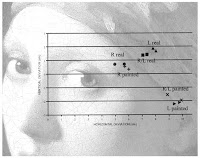 Image Caption:Graph of the distances of the perceived directions of gaze from the center of the peephole at the plane of the observer's face. The graph is superimposed on the girl's face to give a direct comparison with the facial dimensions. The two symbols in each labeled pair represent the Purkinje images present and no Purkinje images conditions. For all symbol pairs, the symbol closest to the peephole (x = 0) corresponds to the Purkinje images present condition, but the separations between symbol pairs are very close and are not statistically significant. (West, 2007) This goes to show that even though Vermeer may have not known at the time; he created an art piece that had a deeper psychological meaning. How amazing is that, not bad for an artist back in the time; creating something in relation to structural mathematical adjustments of the positions of items in the painting. In relation to view and sight, a recent artist named Devorah Sperber, points this out as well in her rendition of the "Girl with a Pearl Earring" art piece called, "After Vermeer II."

 Works Cited:
Russell, I. Jon. “Art Commentary.” Journal of Musculoskeletal Pain 17.3 (2009): 217-220. Academic Search Premier. EBSCO. Web. 7 Oct. 2009.
West, Roger W., and Hank G. Van Veen. “Gaze as Depicted in Vermeer’s Girl With a Pearl Earring. “Journal of General Psychology 134, no. 3 (July 2007): 313-328. Academic Search Premier. EBSCO. Web. 7 Oct. 2009.
 Aloha, Hello, Hi, and Welcome to my blog. This blog was created for my English Unit Four project. In this blog, I will be expanding on my unit two essay, which deals with an interesting art piece displayed in the BAM (Boise Art Museum) and art in general.
 For my English 101 class, we were required to take a trip to the BAM and find an art piece, which had an interest or seemed fascinating to us. during my trip to the BAM, I came across an art piece, which interested me, because I have done previous research on the original painting in high school. The remodeled art piece was called, "After Vermeer II," by Devorah Sperber. The original painting was called, "Girl with a Pearl Earring," by Johannes Vermeer. Many of you may have heard of these two artist before or the art pieces, which are famous around the world.
In this blog, I will be sharing with you some of my opinions and information about art in general, Johannes Vermeer, "Girl with a Pearl Earring" (the original painting), Devorah Sperber, and her remodeled art piece, "After Vermeer II."
I hope you enjoy this blog, whoever may be interested in art in general, the art piece which fascinated me, or the artist themselves. Those of you who view this blog site, I would appreciated your feedback and your opinions about my blog.
Take care..Thanks! :)
 Recently in the year 2006, Devorah Sperber created the art piece, “After Vermeer II,” which is 96” X 100” in size. This art piece became a rendition of Vermeer’s painting, “Girl with a Pearl Earring.” Devorah Sperber is a New York artist [and] has always been fascinated by the science behind vision, curious to understand how viewers experience her artwork (Eye of the Beholder, 2007). In this art piece, Sperber used 5,024 spools of thread on stainless steel ball chains which portray a hanging apparatus. In order to see the painting right side up, a clear acrylic viewing sphere on a metal stand was placed in front of the art piece for people to see the abstract image.


